
GEOFF - THE BOND
The Craftsman has been made the same way since 1932. One piece of leather. Elastic sides. A single seam at the back. Stitched by hand in Adelaide, then sent to a man in Sydney, Melbourne, London, or New York who will wear them for the next fifteen years. The boot is the closest thing in menswear to a permanent decision. Two questions remain. Which colour, and which life.
SILVER FOX VERDICT
If you can only own one Craftsman, make it chestnut with a leather sole. Versatile, considered, dresses up to a jacket and down to indigo denim. The black is the second pair you buy, not the first. The matching belt is not optional. Approved without hesitation.
The Adelaide Standard
Reginald Murray Williams started his boot business in 1932 in the Adelaide hills. The original customers were drovers, station owners, and shearers who needed a boot that could survive a thousand kilometres of red earth and still pass for evening wear at the local pub. Williams designed the answer himself. A single piece of leather wrapped around the foot, no seams along the sides, just elastic gussets for fit and a small loop at the back to pull them on. The construction was a structural solution, not a fashion choice. Boots that come apart at the seams are useless to a man working a cattle station three hundred kilometres from the nearest cobbler.
Ninety-four years later, the construction has not changed. The same one-piece leather, the same elastic, the same hand-stitching. The customers have. The Craftsman now sits in the wardrobes of men in London partnerships and Manhattan corner offices, worn with raw selvedge denim on a Saturday and a charcoal suit on a Wednesday. The boot did not adapt. The world caught up.
Why Leather Sole, Not Rubber
RM Williams offers the Craftsman in three soles. Leather, composition rubber, and yearling rubber for serious country use. Most men reach instinctively for the rubber. A mistake. The leather sole is the right choice for the boot you actually want.
A leather sole reads as a dress boot. The proportions sit cleanly with a tailored trouser. The boot bends naturally with the foot after a few weeks of wear. Resoled by a competent cobbler every three or four years, a leather-soled Craftsman will outlast most marriages. The composition rubber sole is sensible. It is also slightly clunky, slightly utilitarian, and never quite right with a wool trouser. The leather sole is the boot. The rubber is the compromise.
One practical note. Leather soles are slippery on wet marble and polished concrete for the first week. They settle quickly. The Topy half-sole, a thin rubber overlay added by any decent cobbler, solves the issue if it bothers you. Most men leave them alone.
Chestnut: The First Pair
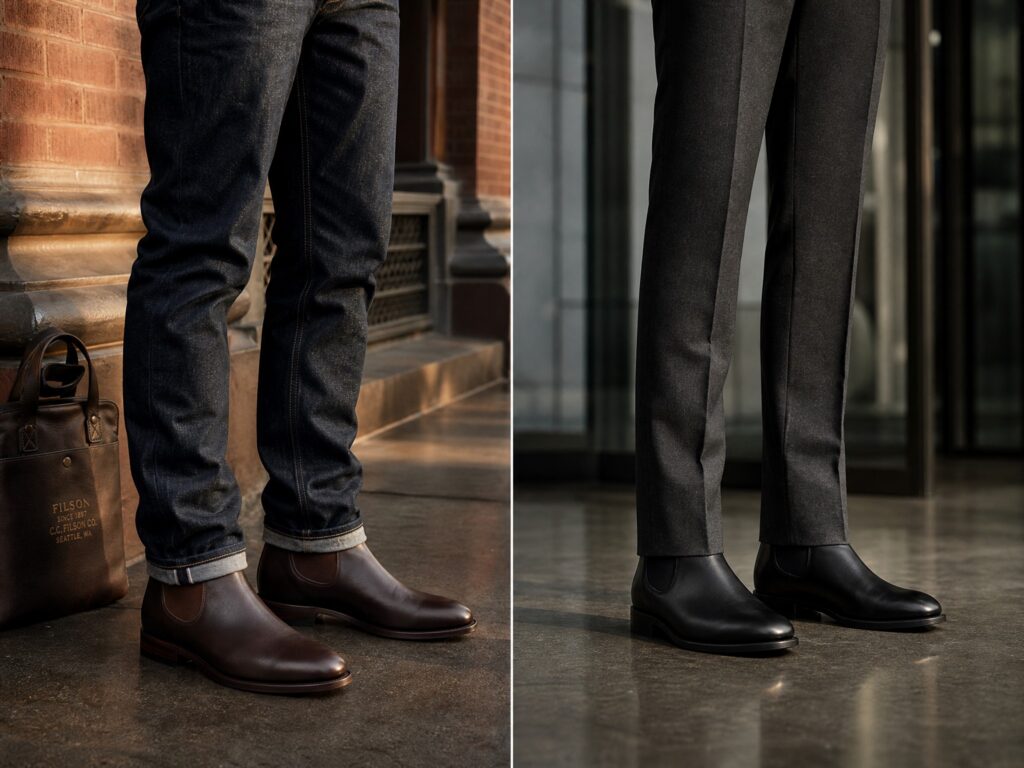
RM Williams Craftsman in Chestnut, Leather Sole
The boot that does everything. Sharp under a jacket, considered with indigo denim, ages into a personal patina. The one to own first.
Chestnut is the most useful colour in menswear. Warm enough to read as casual on a weekend, considered enough to work under a navy suit on a Friday. The leather develops a soft, lived-in patina over two or three years that no factory finish can replicate. Scuffs become character. Creases become signature.
Pair chestnut with raw indigo denim, tan or olive chinos, and any shade of wool trouser from grey to navy. Avoid black trousers, the contrast is jarring. The Craftsman in chestnut should always be worn with a leather belt in the same family of tones, not the same exact shade. A close match looks studied. A loose match looks correct.
Black: The Considered Second
RM Williams Craftsman in Black, Leather Sole
The boot for boardrooms, dark suits, and any context where chestnut is too informal. The second pair, after chestnut earns its place.
Black is the boot for tailored trousers, dark suits, and any context where the dress code leans formal. It is also the more demanding boot. Black leather shows scuffs more readily than chestnut. It demands more frequent attention with a soft brush and a tin of conditioner. The reward is a boot that holds its own against the most considered city wardrobe.
Pair black with charcoal, navy, and grey wool trousers. Black denim works. Indigo denim does not, the contrast reads as costume. Always paired with a black leather belt, never brown.
Most men do not need black Craftsman boots. They need chestnut. If your professional life involves boardrooms, partner meetings, and dark suits more often than not, the black is the right second pair. If it does not, the second pair is another chestnut in a different leather finish, not a black.
The Belt Is Not Optional
RM Williams 1 1/2" Solid Hide Belt in Chestnut
Single piece of solid leather, brass buckle, made on the same factory floor as the boots. Match the leather family, not the exact shade.
The RM Williams belt is made from a single piece of solid hide, the same leather and the same factory as the boots. There is no laminate, no bonded strip, no synthetic core. The belt will last as long as the boots. With proper care, both will outlast the wardrobe around them.
The 1.5 inch width is the right width for jeans and tailored trousers. The 1.25 inch is dressier and works only with suits. Most men should buy the 1.5 inch and stop thinking about it.
Sizing and Care
RM Williams sizing runs roughly half a size smaller than standard Australian shoe sizing. Most men size up a half size from their everyday dress shoe. The boots come in three widths: B (narrow), D (standard), and G (wide). Most men are D. If you are unsure, go to an RM Williams store and have them measured properly. Once is enough. The size will not change for the rest of your life.
The boots need three things. A soft horsehair brush after every wear. A tin of Saphir leather conditioner applied once a month. A trip to a competent cobbler every three or four years to replace the leather sole. That is the full maintenance schedule. The boots will reward this care with two decades of service.
Silver Fox Field Note
A good pair of boots is the longest commitment in a man's wardrobe. They will outlast suits, marriages, careers, and most of the rooms they walk into. The Craftsman in chestnut is the right first pair. The black is the considered second. The belt is the third. After that, you can stop thinking about it. Approved.
JOIN THE EDIT
The weekly briefing for men who want better, not more.