
Julian - The Relatable Historian - Living Well
Elias - The Archival Curator
"Nine paintings. Several have never shared a room. Some have not left their home institutions in decades. The National Gallery has done something genuinely rare here - not just assembled great works, but assembled the unrepeatable. You will not see this again in your lifetime. That is not marketing. That is the archival reality."
Elias - Archival Curator, The Public Domain
In 1432, a Flemish painter completed a work that changed everything about how human beings depicted one another. Not with a grand gesture. Not with a manifesto. With a face.
Jan van Eyck's portraits look at you. Not in the general way that painting looks at you - in the specific, disconcerting, deeply personal way that a person looks at you. The eyes follow. The expression holds something back. You feel, standing in front of a Van Eyck portrait, that the subject has something on their mind and has chosen not to share it.
This was revolutionary. Before Van Eyck, portraiture was largely symbolic - a representation of status, of power, of religious significance. The individual underneath was incidental. Van Eyck made the individual the entire point. He looked at actual human faces and painted what he actually saw. Asymmetry. Imperfection. Personality. The particular quality of light on a particular person's skin on a particular afternoon in Bruges in 1435.
We have been doing it his way ever since.
Nine Paintings. One Lifetime.
Van Eyck was prolific but not in the way we tend to imagine great painters. He worked slowly, with extraordinary precision, on panels of oak. He mixed his own pigments - azurite and smalt for blues, vermilion and red lead for reds, lead white ground into linseed oil for the luminous flesh tones that make his figures look lit from within. He almost certainly invented or perfected the oil glazing technique that would define European painting for the next two centuries.
Of his surviving portraits, nine remain. Nine. In an era when a significant contemporary artist might produce hundreds of works, nine portraits is the entire output of a man who redefined what a portrait could be. Each one survives because it was recognised immediately as something worth preserving. Each one has been in institutional or significant private collection for most of its existence.
These nine paintings are now, for the first and possibly only time, in the same room at the National Gallery in London. Several have not travelled in decades. One has never been shown publicly in the UK before. The logistics of assembling them - the negotiations, the insurance valuations, the conservation assessments, the climate-controlled transport - represent years of curatorial work. The National Gallery has pulled off something that will not happen again.
"He looked at actual human faces and painted what he actually saw. Asymmetry. Imperfection. Personality. We have been doing it his way ever since."
The Man Behind the Brush
Jan van Eyck was born somewhere in the Low Countries around 1390. The exact date and place are unknown - which is fitting for a man whose own self-portrait, if it exists at all, is still debated by scholars. He served as court painter to Philip the Good, Duke of Burgundy, one of the most powerful men in Europe. Philip valued him enough to send him on diplomatic missions - including a secret journey to Portugal in 1428 to paint a portrait of the Infanta Isabella, whom Philip was considering marrying. The portrait was the vetting process. If Van Eyck's rendering was accurate enough to be trusted, Philip could make his decision without having met the woman.
He painted her accurately. Philip proposed. They married. The portrait is lost, but the story tells you everything about the trust Van Eyck commanded. In an age before photography, a portrait painter of his calibre was not an artist in the modern sense. He was closer to a documentary record - a tool of statecraft and commerce as much as art.
Van Eyck died in 1441 in Bruges. He was probably around fifty. Philip the Good paid for his funeral.
What You Will Actually See
The nine portraits span roughly a decade of Van Eyck's mature career - from around 1432 to 1439. The subjects include merchants, civic officials, a goldsmith, and one figure whose identity has never been established. Several of the portraits include inscriptions in the frame - painted inscriptions, part of the composition - that function as the sitter's personal motto or a statement from the painter himself.
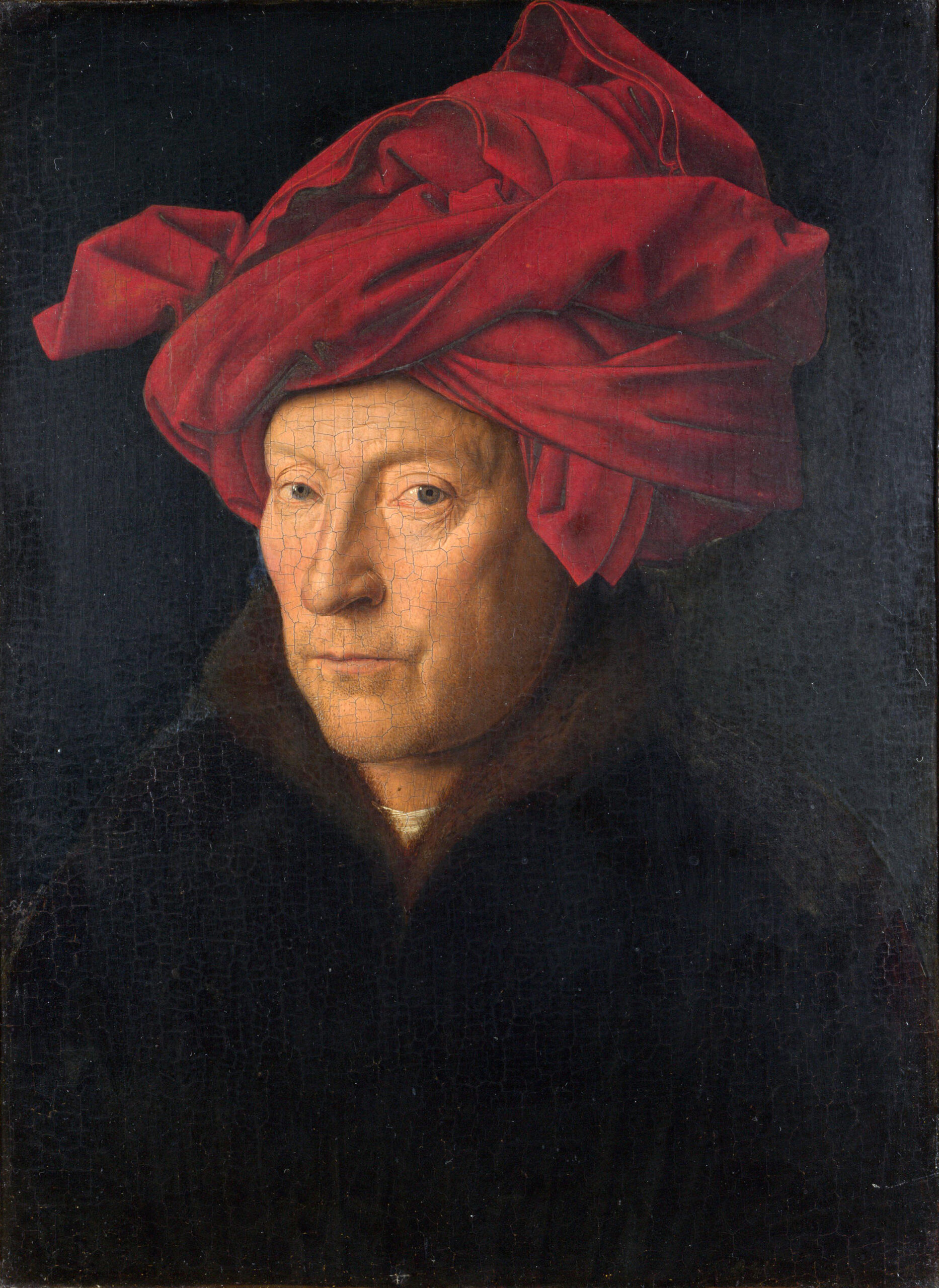
The most famous is the Portrait of a Man in a Red Turban from 1433, held by the National Gallery itself. It is widely believed to be a self-portrait - the direct, slightly challenging gaze, the slight asymmetry of the face, the absence of any identifying inscription. The eyes are the argument. They do not look like a commissioned subject performing for a patron. They look like a man examining himself carefully and painting exactly what he found.
Alongside it hangs Portrait of a Man with a Blue Chaperon, on loan from Bruges. Portrait of a Goldsmith, from Vienna. The Man in a Turban - a different turban, a different man, a different institution. Each portrait is small by the standards of what we expect from major gallery exhibitions. Van Eyck's panels are intimate objects. You have to stand close. That is deliberate - both by the painter and by the curators who understand that these works do not announce themselves from a distance. They reward proximity.
Why It Matters to You
There is a version of art appreciation that involves standing at a respectful distance, reading the wall text, and moving on. Van Eyck does not work that way. You have to stand in front of these portraits for several minutes before they give you anything back.
When they do, what you get is the uncanny experience of genuine contact across six centuries. These are real people. They had opinions. They had worries. One of them apparently had a tendency to look slightly to the left of whoever he was speaking to - you can see it in the set of the eyes. Van Eyck painted that. He noticed it and he kept it in.
For a Silver Ops man - someone who has spent decades in rooms with people, reading faces, making judgements - there is something particular about standing in front of a Van Eyck portrait. The painter's entire method was close observation. The same skill you have spent a career developing. Looking carefully. Noticing the thing slightly off. Painting what is actually there rather than what is supposed to be there.
It is worth the flight to London. It is worth an afternoon of your time. It will not happen again.
Exhibition Details
- Exhibition
- Van Eyck: The Portraits
- Venue
- The National Gallery, Trafalgar Square, London WC2N 5DN
- Dates
- 2026 - check nationalgallery.org.uk for current dates and booking
- Admission
- Ticketed - book in advance, this exhibition will sell out
- Getting There
- Charing Cross or Leicester Square underground. Five minute walk.
- Worth Knowing
- Weekday mornings are significantly quieter. Book the first session of the day if possible. These portraits require space and time - a crowded room does not serve them.
- Nearby
- The Wolseley on Piccadilly is twelve minutes on foot. A worthy lunch before or after.
Silver Fox Field Note
"Nine portraits. The man who invented portraiture. One room, one chance. Some things are worth arranging a trip around. This is one of them."
Julian - The Relatable Historian
Julian covers the human stories behind great art - the decisions, journeys and obsessions that produced the work. He writes for the man who did not study art history but finds, when someone tells him the story properly, that he wishes he had.