
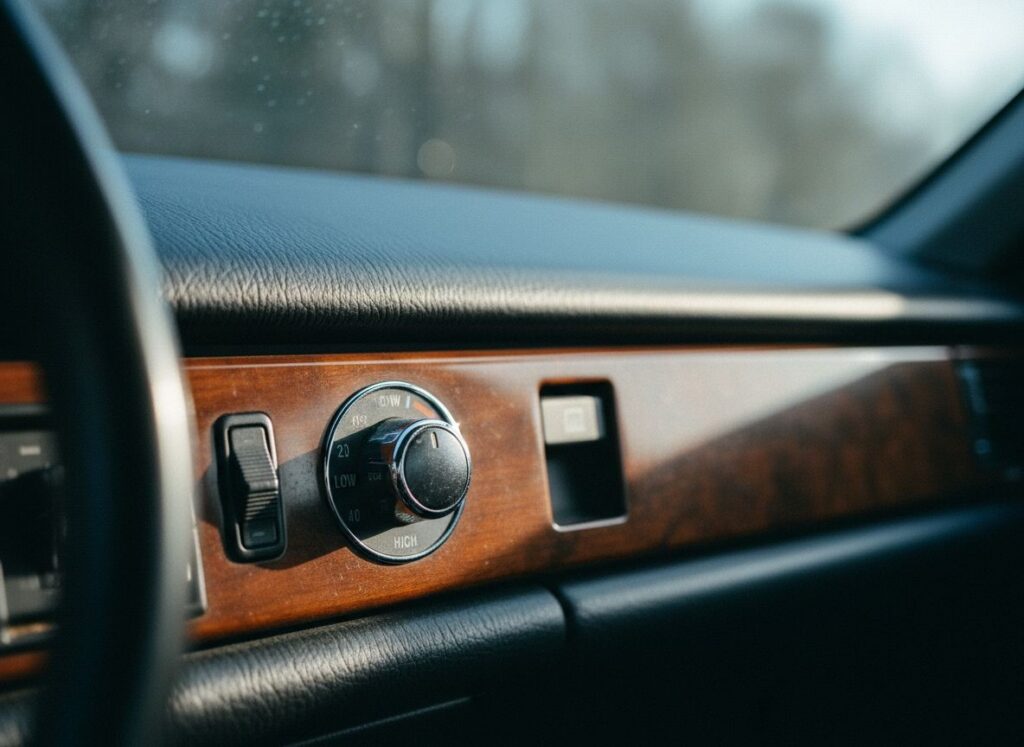
The Mercedes I drove in 1994 had a single rotary dial for the climate. You turned it. The cabin warmed. There was no menu. There was no software update. The dial did one thing perfectly for fifteen years and was thrown out with the car.
The car I drove last month has a 14 inch touchscreen. To change the temperature I navigate three sub-menus while looking at the road I am supposed to be watching. Engineers will tell you this is progress because the screen can do many things. It can. It just cannot do any of them as well as the dial did the one thing.
There is a pattern here that runs deeper than cars. We have spent two decades replacing tools that did one thing with tools that do many things. The result is rarely more capability. The result is usually more friction, more failure modes, and more software between the operator and the action.
The justification for the touchscreen was always cost. A capacitive screen costs less to build than thirty discrete buttons and dials. The cost saving was real. The compromise was hidden inside it.
A physical control gives you three pieces of information for free. You feel where it is. You feel the resistance as you turn it. You feel when it has clicked into a new position. The brain processes all three without looking. A touchscreen gives you none of those. It demands your eyes, every time, for every action.
The men who learned to drive on cars with three pedals and a handbrake notice this more than most. We were taught that the interface should disappear so the driver could concentrate on the road. That instinct has not aged. The road is still the point.
Notice which premium manufacturers are quietly returning to physical controls. Porsche kept their analogue layout through the entire screen era and is now praised for the discipline. Aston Martin redesigned the new DB12 around a hybrid interface with physical buttons for everything that matters. Even Volkswagen has formally admitted the touchscreen war was a mistake and announced a return to dials and buttons across its range.
The lesson is not about cars. The lesson is that complexity is not the same as quality. A good tool does one job so well that you forget you are using it. A bad tool reminds you constantly that it exists.
You see the same pattern in kitchens. The professional cooks I know use the same three knives they bought twenty years ago. The home cook has a drawer of single-purpose gadgets that get used twice. You see it in audio. The amplifiers that aged best had three knobs and a switch. The ones loaded with features were obsolete in five years.
The men who built things for a living already knew this. The industry is only just catching up.
The dial is coming back not because it is nostalgic but because it was right. The first generation of engineers who removed it were optimising for cost. The next generation is optimising for use. The difference is the customer they were thinking about.